
Retail turnover in Ukraine increased by 17.7%
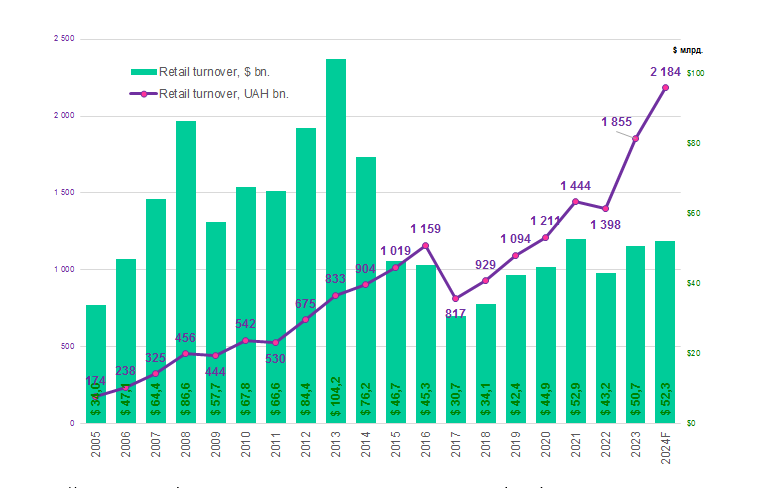
UTG experts are constantly studying the state of the Ukrainian market. Thus, according to analysts, by the end of 2024, the retail turnover in Ukraine is expected to amount to 2.184 trillion UAH, which is +17.7% more than in 2023 (1.822 trillion UAH). The turnover is also growing in dollar terms (+3.1%). However, despite the positive dynamics, the market continues to experience the negative impact of previous years.
According to UTG experts, the growth in absolute values of retail turnover was influenced by the increase in inflation (about 12.0%) and the exchange rate of the Ukrainian hryvnia to the US dollar (approximately 41.75 UAH per $1). Also among the negative factors, the main impact is exerted by:
Firstly, limited reserves for the growth of retail trade: mass outflow of the population abroad, a decrease in the number of children (which causes a lack of demand for children’s entertainment, education, goods and toys), the closure of many luxury-segment stores, a drop in demand for leisure and recreation for adults due to the curfew (which leads to a low feasibility of buying evening clothes), restrained work of entertainment operators – cinemas, shopping centers, bowling alleys, sports and catering establishments, and the consequences of the pandemic (which causes a limited need for clothing due to remote work).
Secondly, optimization of income and the number of stores. Which encourages retailers to focus exclusively on profitable objects and close unprofitable points of sale and reduce costs for: advertising, marketing, total savings on utility bills, heating, air conditioning, electricity, water. Sellers are also struggling with logistical problems, a shortage of marketable products, rising prices for raw materials, and a shortage of personnel.
Thirdly, the reserves of the population’s surge demand for 2022/2023 are almost exhausted: life support systems to counteract the consequences of the war (solar panels, charging stations, generators, autonomous Internet, flashlights, stoves, radiators, batteries), overstocking of food supplies, medicines, and hygiene products.
One thought on “Retail turnover in Ukraine increased by 17.7%”
Comments are closed.