
Price indices in July 2026 – State Statistics Service
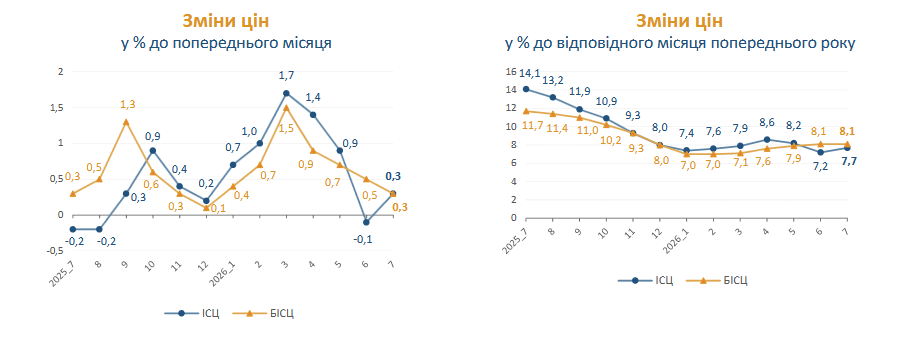
UTG company experts constantly analyze statistical indicators of the Ukrainian market. According to the data of the “State Statistics Service of Ukraine”, inflation on the consumer market in July 2026 compared to June was 0.3%, and from July 2025 – 7.7%. At the same time, core inflation in July of the current year compared to June was 0.3%, and from July 2025 – 8.1%
In particular, on the consumer market in July, prices for food products and non-alcoholic beverages decreased by 0.2%. The prices of eggs and vegetables fell the most (by 6.0% and 5.9%). Prices for pork, poultry, processed grain products, and lard decreased by 1.3–0.6%. At the same time, the prices of fruits, fish and fish products, sunflower oil, soft drinks, milk and dairy products, bread, pasta, and sugar increased by 1.5–0.6%. At the same time, the prices of alcoholic beverages and tobacco products increased by 1.5%, which is connected with the increase in the price of tobacco products by 1.8%. If we consider clothes and shoes, they fell in price by 4.8%, in particular, clothes – by 5.8%, shoes – by 3.5%.
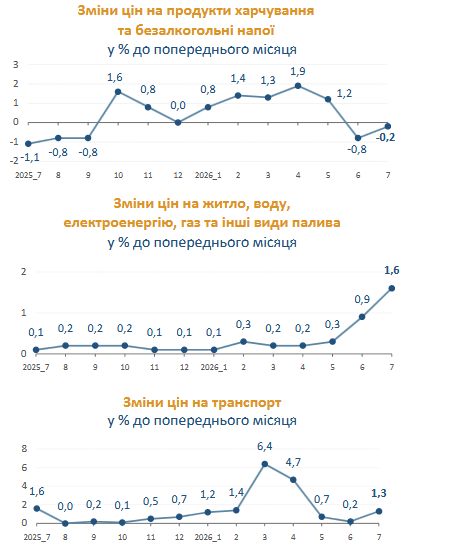
At the same time, an increase in prices (tariffs) for housing, water, electricity, gas and other types of fuel by 1.6% was observed, mainly due to an increase in tariffs for water supply by 31.9%, sewage – by 29.8%. Transport prices also increased by 1.3%, mainly due to the increase in road and rail passenger transport fares by 6.0% and 2.7%, respectively.
Geographic coverage
The data are given without taking into account the territories temporarily occupied by the Russian Federation and part of the territories where hostilities are (were) taking place. The selection of cities is carried out at the state level and is representative for the calculation of the CPI for each region of the country. Monitoring of changes in consumer prices (tariffs) is not carried out in rural areas.
Main indicators
The consumer price index (CPI, inflation) is an indicator of changes over time in prices and tariffs for goods and services purchased by the population for non-productive consumption. It is calculated monthly on the basis of price data (obtained by state statistics bodies through monthly registration of prices and tariffs on the consumer market) and data from national accounts on household final consumption expenditures for the country as a whole with further distribution (based on the results of a sample survey of household living conditions).
The base consumer price index (BCPI, core inflation) is a sub-index of the consumer price index. Its construction is based on existing methodological principles for calculating the consumer price index. BCPI shows stable price dynamics with minimization of short-term uneven price changes caused by supply shocks and administrative regulation.
Methodology
The formation of indicators is carried out based on the results of the state statistical observation “Changes in prices (tariffs) for consumer goods (services)”, the methodology of which takes into account the general requirements of Convention 160 of the International Labor Organization of 1985 (Article 12), the Resolution on Consumer Price Indices adopted at the 17th International Conference of Labor Statisticians (2003), Regulation (EU) No. 2016/792 of May 11 2016, Executive Regulation of the Commission (EU) No. 2020/1148 of July 31, 2020, as well as “Guidelines on consumer price indices: Concepts and methods”, prepared by the International Monetary Fund, the International Labor Organization, the Statistical Office of the European Community (Eurostat), the Economic Commission for Europe of the United Nations, the Organization for Economic Cooperation and Development (OECD) and the World Bank (2020).